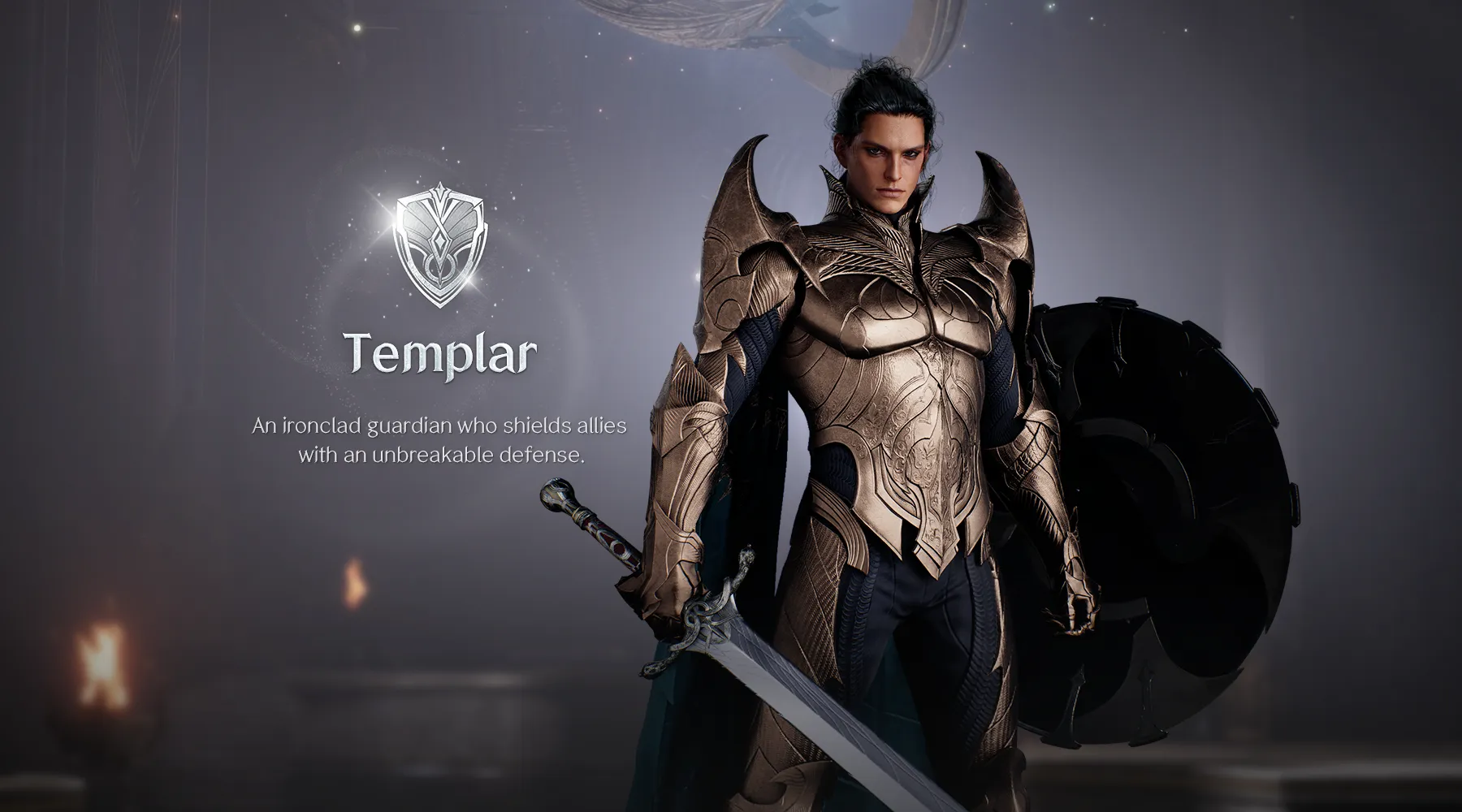
Is Templar for you?
You enjoy leadership
You want to shape enemy movement and make difficult pulls predictable.
You dislike preparation
Groups often expect the tank to understand routes and mechanics.
| Range | Melee |
| Identity | Tank and control |
| Learning curve | Moderate |
| Party job | Positioning and protection |
Core tanking habits
Face danger away
Give allies a safe, readable side of the encounter.
Move with purpose
Reposition only when mechanics or control demand it.
Rotate defenses
Plan mitigation instead of spending everything on the first threat.
Templar skills: when to use them and what to check
Three existing community client-data samples from build 0.0.4387.0; skill details reviewed October 7, 2026. Practice guidance added October 11. Current-client behavior is not independently tested; these exercises are not damage rankings or a fixed rotation.
Judgment
Situation: Follow an available trigger.
Close-range strike that increases enmity.
- Confirm in your client
- Watch the follow-up indicator after Shield Smite while keeping the party target.
- Common mistake
- Losing the target while concentrating on the follow-up.
- If it does not work
- Keep your normal threat response available if the indicator does not appear.
Poach
Situation: Reposition an enemy.
Pull a target toward the caster and attempt to immobilize it.
- Confirm in your client
- Check the intended destination and party positioning before testing a pull.
- Common mistake
- Pulling an enemy away from the group or assuming immunity never applies.
- If it does not work
- If the pull fails, preserve the group position and inspect range or immunity.
Shield Smite
Situation: Check nearby control.
Nearby area strike with a stun chance and a short Judgment follow-up window.
- Confirm in your client
- Observe the stun attempt and Judgment indicator separately.
- Common mistake
- Treating a control chance as guaranteed.
- If it does not work
- If the target resists, use the defensive response already available to you.
Community class tooltip source ↗ · Extraction methodology ↗
Record one useful practice result
- Choose one unlocked skill and one safe practice situation.
- Keep the same target, skill rank and equipment. Observe the effect or activation condition before adding another action.
- Write the result, failure condition and alternative in your build notes. Retest before using it in group content.
Named skills and a practice sequence
Community extraction of Global build 0.0.4387.0, reviewed October 3, 2026. These are base cooldowns and source unlock fields, before modifiers. The sequence below is an editorial exercise based on tooltip conditions, not a tested optimal rotation.
| Skill | Unlock | Base cooldown | Use / condition |
|---|---|---|---|
| Judgment | 4 | 5s | Check its current tooltip and trigger before use. |
| Poach | 1 | 15s | Pulls a target toward you; agree the pull before using it. |
| Shield Smite | 3 | 10s | Can stun and opens a brief Judgment window. |
Practice before using a fixed rotation
Agree the pull, use Poach if appropriate, then test Shield Smite followed by Judgment while its trigger is available. Return to positioning and threat control before repeating.
Compare gear for your actual role
The source lists Longsword as this class weapon. Begin with usable quest upgrades. Compare one change at a time with the same target, skill levels and encounter conditions; record damage or healing uptime, resource use and deaths. These samples do not establish best-in-slot gear or a numerical stat priority.
Class skills and tooltip source · Preview this class practice plan · Methodology
Templar: practice before your next group run
Editorial practice exercises reviewed October 3, 2026. These are not verified skill rotations or boss-specific counters. Use skills currently unlocked in your Global client and read their tooltips before testing.
| Situation | Response to practice | Exercise |
|---|---|---|
| Starting a pull | Agree on the next target and wait for party readiness before initiating. | Mark a target, confirm the group is ready, then practice keeping the encounter in one readable location. |
| A teammate is pressured | Check target and threat indicators in your client; use only skills whose actual effects you have read. | Locate the target indicator and your available defensive tools before the next pull. |
| A dangerous attack repeats | Choose a response from the observed cue; do not spend every defensive option at the start. | Assign one available defensive response to one observed cue and record whether it helped. |
Turn practice into a usable build note
- Choose one situation above and one safe target or party practice opportunity.
- Write down the exact skill names, target restrictions and response that worked. If a tool is not unlocked, leave it out.
- Repeat under similar conditions. Change one action at a time and record failures as well as successes.
- Add the resulting sequence and its limitations to your class build draft; keep one available response for movement or danger.
Launch practice plan
| Basic loop | Establish threat, face danger away from allies, control movement, and save a defensive answer for the real hit. |
| Before a dungeon | Know the pull plan, interrupt, emergency defense, and a safe pace the party can read. |
| Common mistake | Using every defensive cooldown early or moving the boss without warning. |
| Verify at launch | Threat rules, block and mitigation behavior, taunt limits, Stigma options, and encounter responsibilities. |
Starter build direction
Prioritize reliable control, mitigation, and recovery before personal damage. Battlefield Banner was added as a regional Templar Stigma; confirm the global effect and party value before investment.
Turn this class guide into your own plan
- Inspect Templar skill references and activation conditions.
- Record your skill and equipment priorities. Existing draft fields stay under your control; adding a source reference requires confirmation.
- Review a skill-check action for your current character.
Reference data is not a tested rotation. Check the current client before spending resources.
Templar plans for three situations
Global reference · build 0.0.4387.0 · reference review October 3, 2026 · live testing pending
Record one successful response and one failure for your chosen scenario. Korean ranking reference: separate supplementary material.
Choose the situation you actually play. These are editorial practice plans built around the existing Global-client skill references, not tested best builds. Each preview uses the same three reference samples; its goal and evaluation change by situation.
| Situation | Goal | Plan |
|---|---|---|
| Leveling | Practice approaching without pulling another pack. | Preview leveling plan |
| Solo progression | Compare survival and recovery before increasing pull size. | Preview solo progression plan |
| Dungeon groups | Agree who leads the pull; keep enemies positioned away from allies. | Preview dungeon groups plan |
Choose passives and Stigmas by the problem you observed
- Record whether your attempt failed through missed activation, movement, resource shortage or recovery.
- Read the current tooltip of one unlocked passive or Stigma that addresses that problem. Check prerequisites and permitted slots.
- Keep the rest of the setup unchanged and repeat the same encounter. Compare uptime, recovery, resource use and failures.
- If the option is unavailable or the result is worse, retain the previous choice. Save the result and limitation in your build notes.
Stigma planning · Compare an equipment change · Add a skill-review action